


The Human Development Index (HDI) is a way of measuring development in a country and throughout the world. As a whole, HDI uses three basic characteristics to measure including health, knowledge, and a decent standard of living. Life expectancy is used for calculating health. Knowledge is based off the combination of the adults literacy rate and the combined primary, secondary, and tertiary gross enrollment ratios. Finally, the standard of living is figured through the Gross Domestic Product (GDP) per capita, the Purchasing Power Parity (PPP) dollars. The PPP takes into account the price differences between countries.
Through the human development index you can see the differences in development throughout the world. Over time, the human development has improved greatly. In 1980, practically all of Africa, Asia, and most of Europe had low human development. Just ten years later, most every country had improved and Russia jumped to high human development, but ten years following, fell back to low again. By 2000, most of Asia had reached a medium level of human development. The world is off balance when looking at HDI. North America, Australia, and Europe are pretty much all either in high or very high ranking for human development where as Asia and especially Africa are undoubtedly lacking. Although Asia is improving, Africa still struggles to this day with human development.
When looking at the HDI rankings, it didn't surprise me to find most of the low human development countries to be in Africa. Reasons for Africa's low human development may be unknown, but numerous factors may play a roll in the ratings. The fact that AIDS is spreading throughout several countries results in the health rates for calculating HDI to drop. Knowledge is hard to calculate because there are so many things to apply as knowledge or ignorance. Education in schools is very low due to affordability and adequate facilities. Besides that, most African people live in less than adequate homes or on the street because of the lack of money to afford better options. The amount of money a person makes each day in Sub-Saharan Africa cannot even be compared to the amount Americans make each hour. All these factors uncover a few of the reasons Africa is ranked so low in human development. Other countries are so well off; it is crazy to think that anyone living somewhere else, especially in the United States, can feel like they are without money when there are so many people elsewhere with so much less. Looking at these statistics really opens eyes for people who don't realize how blessed they truly are.
Tuesday, March 9, 2010
Monday, March 8, 2010
Blog Post #4
Doctors Warn of Health Threat From Chile Wreckage - International News | News of the World | Middle East News | Europe News - FOXNews.com
February 27, 2010, disaster struck the country of Chile with a terrible earthquake. Tsunami waves crashed into the shore-line cities as the people of Chile tried to take cover. The earthquake in Chile, taking place only weeks after the destructive quake in Haiti, is causing diseases to spread through the water conditions and lack of appropriate medical care. Six days after the quake, people in Chile were still facing 6.6 magnitude aftershocks from the 8.8 magnitude earthquake. The death toll in Haiti, however, far out-numbered the one in Chile. Reconstruction is estimated to cost $30 billion. Besides the earthquake, Chile just inaugurated a new president on March 11, Sebastian Piñera.
The earthquake in Haiti was unexpected at the time, but not a surprise when looking at the tectonic plates. Chile is the same way. As mentioned in class, Chile is located right next to the Nazca plate that runs along the west coast of South America. The movement of the plate disrupts the ground and causes it to shift and shake causing much destruction throughout the land. In Chile, the quake also caused tsunami waves to wash into the cities. This water that washed ashore is only adding to the spread of disease throughout the people. Doctors located there are having trouble aiding to everyone with the aftershocks recurring a week after the earthquake. Although Chile is a developed country, tragedies like this can have a huge effect on the population.
The country of Chile is not very large having a population of just over 16 million people (in 2007). The percent of urban living, however, is 88 percent. The northern part of Chile is a desert, adding to the fact that most of the Chile population lives in urban areas. When the earthquake hit the city of Concepción, many people were affected. Chile, a country that is usually sending aid to other countries was, this time, receiving rescue aid and relief. Chile is looking for the necessities first, like mental health care for the earthquake survivors, removing trash from the city streets, providing drinking water and shelter. God will provide for His people, we are all in His hands.
It is interesting that the Haiti earthquake was much more publicized than the one in Chile. I guess the fact that Chile is a developed country makes a big difference. The high death rate in Haiti compared to Chile also made a difference. Haiti lost thousands of people in the earthquake where as Chile has lost a mere 500 in comparison. However, since Chile is developed, the ability for them to step back up from the disaster is a far greater chance than the country of Haiti. The magnitude is not the only factor when rating earthquakes. The development of the country and total population also play a roll. Not only is Haiti trying to recover from an earthquake, but Chile is also; Haiti's recovery just might take a little longer. God works through everyone and He would never throw something our way if He didn't think we can handle it. Just pray!
February 27, 2010, disaster struck the country of Chile with a terrible earthquake. Tsunami waves crashed into the shore-line cities as the people of Chile tried to take cover. The earthquake in Chile, taking place only weeks after the destructive quake in Haiti, is causing diseases to spread through the water conditions and lack of appropriate medical care. Six days after the quake, people in Chile were still facing 6.6 magnitude aftershocks from the 8.8 magnitude earthquake. The death toll in Haiti, however, far out-numbered the one in Chile. Reconstruction is estimated to cost $30 billion. Besides the earthquake, Chile just inaugurated a new president on March 11, Sebastian Piñera.
The earthquake in Haiti was unexpected at the time, but not a surprise when looking at the tectonic plates. Chile is the same way. As mentioned in class, Chile is located right next to the Nazca plate that runs along the west coast of South America. The movement of the plate disrupts the ground and causes it to shift and shake causing much destruction throughout the land. In Chile, the quake also caused tsunami waves to wash into the cities. This water that washed ashore is only adding to the spread of disease throughout the people. Doctors located there are having trouble aiding to everyone with the aftershocks recurring a week after the earthquake. Although Chile is a developed country, tragedies like this can have a huge effect on the population.
The country of Chile is not very large having a population of just over 16 million people (in 2007). The percent of urban living, however, is 88 percent. The northern part of Chile is a desert, adding to the fact that most of the Chile population lives in urban areas. When the earthquake hit the city of Concepción, many people were affected. Chile, a country that is usually sending aid to other countries was, this time, receiving rescue aid and relief. Chile is looking for the necessities first, like mental health care for the earthquake survivors, removing trash from the city streets, providing drinking water and shelter. God will provide for His people, we are all in His hands.
It is interesting that the Haiti earthquake was much more publicized than the one in Chile. I guess the fact that Chile is a developed country makes a big difference. The high death rate in Haiti compared to Chile also made a difference. Haiti lost thousands of people in the earthquake where as Chile has lost a mere 500 in comparison. However, since Chile is developed, the ability for them to step back up from the disaster is a far greater chance than the country of Haiti. The magnitude is not the only factor when rating earthquakes. The development of the country and total population also play a roll. Not only is Haiti trying to recover from an earthquake, but Chile is also; Haiti's recovery just might take a little longer. God works through everyone and He would never throw something our way if He didn't think we can handle it. Just pray!
Wednesday, March 3, 2010
Blog Post #3
The map below on infant mortality illustrates the number of babies who die during their first year of life. Looking at the map just shows how well off Americans in the United States are when it comes to the life of their newborn children. In 2002, 7.2 million infant deaths were recorded worldwide; that is 5.4% of all babies born that died within the first 12 months. Of those that died, 2.3% had passed away in the first week. The map show India extremely expanded, which makes sense; India had the most infant deaths reaching 2.7 million, 27% of the World's total. In 22 territories, all being in Africa, the death rate for infants is over 1 death for every 10 live births. The highest rate is in Sierra Leone; 16.5 babies die out of every 100 born alive.

Infant
Mortality
It is devastating to see how Africa and India suffer from infant mortality. The spread of diseases in India really affects the infant mortality rate. Although there are many more people in India, when looking at population, but 2.7 million deaths is a huge number. Africa also suffers greatly in this area. Being an undeveloped people, the amount of care and ability to avoid illnesses are harder to find. AIDS, being a big problem in Africa, surely plays a role in the number of infant deaths as well. I cannot even imagine having 1 out of every 10 children dying. Looking at South America, I am almost surprised that the infant death rate isn't higher, but it also puts things into perspective since South America seems so much better off in this area. The whole situation can be switched around; it all depends on how you look at things.
In a different map, Killed by Extreme Temperature, India is again greatly enlarged. I find it interesting how India can have such a huge population yet have high rates on death counts. The map shown below demonstrates the number of people killed by extreme heat or cold waves from the year 1975 to 2000. Although the numbers are less than the infant count, over 15,000 deaths due to extreme temperatures were reported in those years. The most deaths have occurred in India, the United States, Greece, and Mexico. In rank, Greece comes in with the most in value at 3.8 and the United States is ranked 9th with 0.3. At a first glance, India looked, by far, the greatest, but when considering the size and population of the county, it is understandable that it isn't as high as it appears. Greece, on the other hand, is a rather small country and it being enlarged to the size of Europe is substantially contrasting. I was very surprised that the values in South American and African countries wasn't higher. The temperatures are extreme and they have lesser amounts to cool themselves with air conditioning. The reason, however, makes sense. The main problem with the extreme temperatures is when they are out of the ordinary and unexpected. Since people and Africa and South America live in the hot and humid temperatures everyday, they have adapted to the amount or heat and just merely gotten used to the climate, where as in Asia and the United States, the summers can be extremely hot, but the winters can be very cold as well. When looking at these maps, it is interesting to see the different things that affect a country and to what degree they are being affected; the viewer gets to see the world in a different perspective and with that, see the world through new eyes.

Killed
By
Extreme
Temperature
Monday, March 1, 2010
Blog Topic #2
When I think of South America, I think of Brazil and the huge amount of life that inhabits there, including the people, wildlife, and plant growth. In contrast, I think of Antarctica as ice and the unlivable atmosphere. These two places seem so far away in my mind it is hard to comprehend that they are actually much closer that I realize. A normal map shows South America on the left side and Antarctica on the bottom, but my picture has Antarctica toward the top. I thought this image was very interesting. It shows that our minds can be deceiving. South America and Antarctica are very close, yet their cultures are extraordinarily different. Besides the fact that Antarctica is covered with ice, the amount of life is extremely minimal, very contrasting to the common South American picture in my mind. I find it interesting that we, as a people, can assimilate distances with respect to geographical features (at least I do). I envisioned South America and Antarctica being many miles apart, but found that they are much closer that I had imagined. 

Since South America is so close to Antarctica, it shouldn’t be surprising that the Southern point would have glaciers; however, it still amazes me what God can create to be so beautiful and perfect. On the right side of the photo you can see the tectonic plates along the southern side of South America. Through these plates it is like you can see the fingerprints of God shaping the land, and I find that to be remarkable. Latin America is not just a region south of the United States, but it is a land formed by God. Whether the people know it or not, they are persons of God. The glaciers and plates are just portions showing His handiwork. 
Monday, January 18, 2010
Blog Post #1
People of the United States cannot even imagine the devastation the earthquake in Haiti caused. We have a tendency of living our lives as if we are in our own little world. The attacks on 9/11 were catastrophic but the almost 3,000 victims does not even compare to the 45 to 50 thousand people that have died in Haiti. In the video, streets are filled with the fallen victims and the injured have few places to find first aid.
The earthquake has left thousands of people with nowhere to go and nothing to eat or drink. This natural disaster was so unexpected, as was the Tsunami disaster in New Orleans, that the people in this country are without any of their basic necessities. Transporting aid to New Orleans, however, had to be much easier than trying to land huge airplanes on the demolished runway on the island of Haiti. Many of the dead cannot even be identified, but merely thrown into a grave with other casualties. Numerous parents have lost their children and countless children have lost their parents. The video really opened my eyes to the pain and destruction the people of Haiti have to face. Even in this violent incident, the people of Haiti are still fighting their way through the wreckage to find the light at the end of the tunnel, to find a better ending. Hope still exists through Christ. Despite our incompetence, God is always there to help us along the way.
The look on this young child's face could break your heart. I cannot even imagine being the mother with no care to give but the hope for a better day. Great amounts of care is needed in Haiti, but in most cases the help is unable to reach everyone. Many others, like this young boy, are at risk of obtaining an infectious disease. There is such a high number of injuries that the aid cannot keep up. The lack of first aid is likely to cause an increase in the spread of diseases and eventually more fatalities if aid is unable to reach them in time. Overall, the photo expresses the need for care not only in medical needs but also in prayer. Christ is the only one with the power to save the whole world and we are his servants, here to help serve and spread the great news of His unending love for each and every one of us.
The earthquake has left thousands of people with nowhere to go and nothing to eat or drink. This natural disaster was so unexpected, as was the Tsunami disaster in New Orleans, that the people in this country are without any of their basic necessities. Transporting aid to New Orleans, however, had to be much easier than trying to land huge airplanes on the demolished runway on the island of Haiti. Many of the dead cannot even be identified, but merely thrown into a grave with other casualties. Numerous parents have lost their children and countless children have lost their parents. The video really opened my eyes to the pain and destruction the people of Haiti have to face. Even in this violent incident, the people of Haiti are still fighting their way through the wreckage to find the light at the end of the tunnel, to find a better ending. Hope still exists through Christ. Despite our incompetence, God is always there to help us along the way.
The look on this young child's face could break your heart. I cannot even imagine being the mother with no care to give but the hope for a better day. Great amounts of care is needed in Haiti, but in most cases the help is unable to reach everyone. Many others, like this young boy,
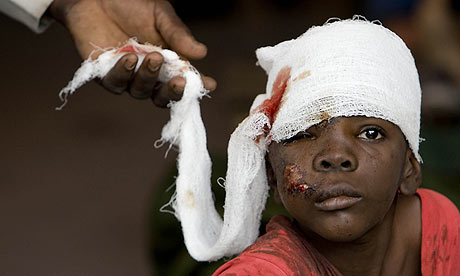 are at risk of obtaining an infectious disease. There is such a high number of injuries that the aid cannot keep up. The lack of first aid is likely to cause an increase in the spread of diseases and eventually more fatalities if aid is unable to reach them in time. Overall, the photo expresses the need for care not only in medical needs but also in prayer. Christ is the only one with the power to save the whole world and we are his servants, here to help serve and spread the great news of His unending love for each and every one of us.
Subscribe to:
Posts (Atom)